Greek name-form · Milesian
Ἶσις
Ι 10 + Σ 200 + Ι 10 + Σ 200 = 420. Greek name. Greek system.
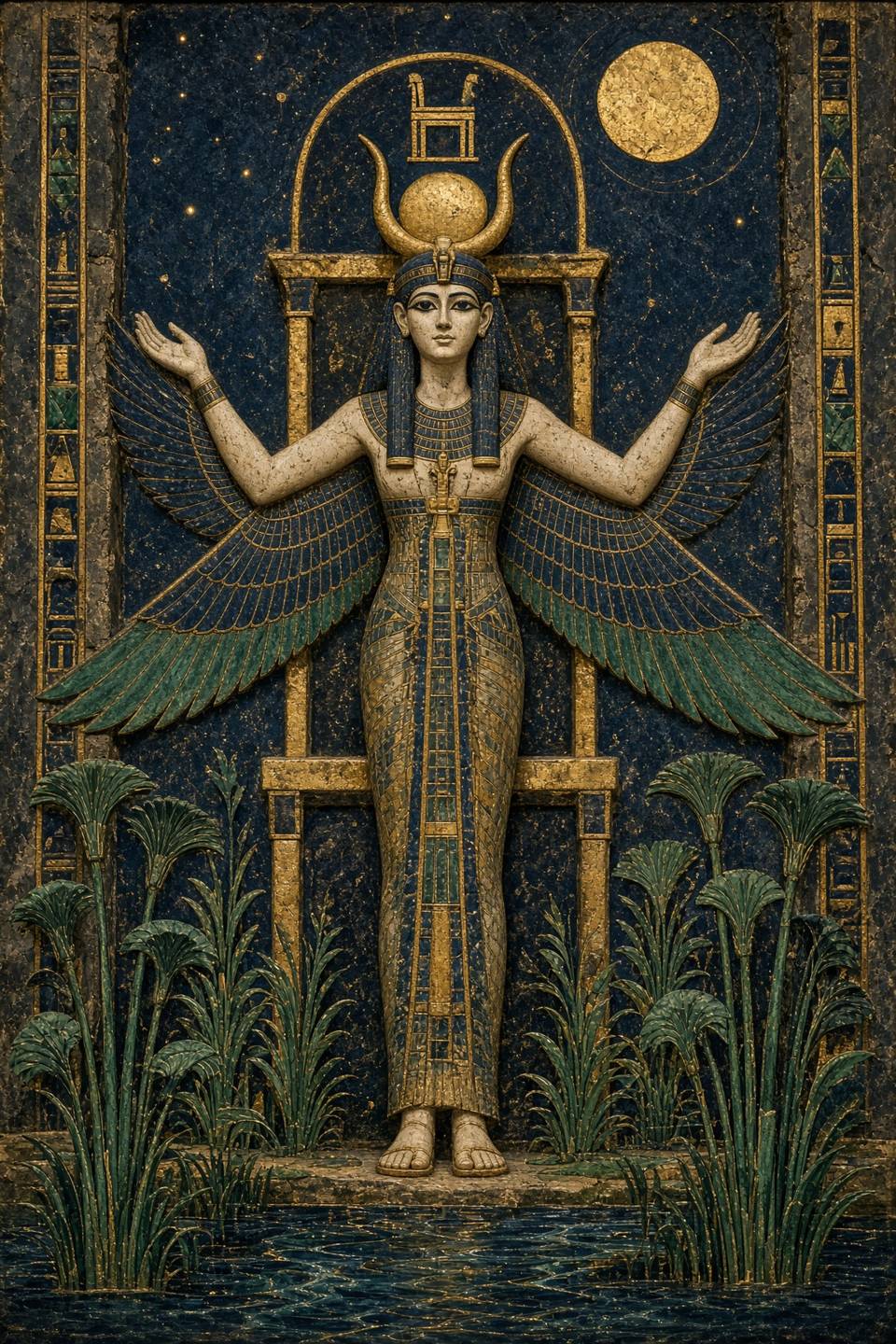
Egyptian tradition · Greek name-form
The name, not the number
Isis belongs to Egypt. This spelling is Greek. CIPHER will not say the goddess is 420 in ancient Egyptian. That would be false.
Hear
Eve · the name, not the number
Eve reads this plate. Not the whole room. No autoplay.
No autoplay. Press play if you want to hear Eve. The words she reads will open below.
Before the calculation
Isis belongs to the religious world of ancient Egypt, where she became one of its most enduring sacred figures, associated across long periods and changing traditions with kingship, protection, mourning, restoration, motherhood, and the story of Osiris.
The story that made her travel is a search. Osiris is killed and scattered. Isis does not accept the scattering. She gathers what can be gathered, mourns what cannot, and restores a king and a child to a world that had been cut apart. Restoration is her office: a body, a house, a name, made whole enough to go on.
Her worship travelled far beyond Egypt. Greek and Roman communities encountered her, wrote her name in their own languages and scripts, and built temples devoted to her across the Mediterranean world.
The form Ἶσις is Greek. That distinction matters. It is a Greek rendering of an Egyptian name, not an Egyptian alphabetic number. Ancient Egyptian writing and Milesian Greek numerals are different systems with different histories.
So CIPHER will not say: “Isis is 420 in ancient Egyptian.” That would be false.
Then we counted the Greek name
420
Under Greek isopsephy, after the documented normalization. The original form remains visible: Ἶσις → ΙΣΙΣ. The word comes first. The values are a second operation. Nothing disappears silently.
The letters, then the values, then the total. The name is still there.
Original language first
Greek name-form · Milesian
Ι 10 + Σ 200 + Ι 10 + Σ 200 = 420. Greek name. Greek system.
English spelling · ordinal
I 9 + S 19 + I 9 + S 19 = 56. A miss, kept so the transliteration cannot impersonate the Greek sum.
It does not show that the Egyptian religious tradition encoded the number 420.
It does not establish a hidden relationship among Isis, Sirius, asteroid (42) Isis and the number 420. Those are separate observations with separate histories.
Asteroid (42) Isis carries 42 as a catalogue designation. DOG STAR is 42 under English reverse reduction, a later wink, after verification. Neither is the same kind of numerical object as the Greek name-form Ἶσις, which is 420.
The 42 confessions of Maʽat are a textual count in Egyptian tradition. They are not this 420. CIPHER keeps them separate before placing anything beside anything else.
Greek name.
Greek system.
420.
The historical Isis is Egyptian. The numerical operation here is Greek.
Notes