English reduction · the lock
ENHEDUANNA
42
E 5 + N 5 + H 8 + E 5 + D 4 + U 3 + A 1 + N 5 + N 5 + A 1 = 42. The poet bound to the road. Not Sumerian.
Independent first · history first · then the cipher
Before the number, a name from more than four thousand years ago.
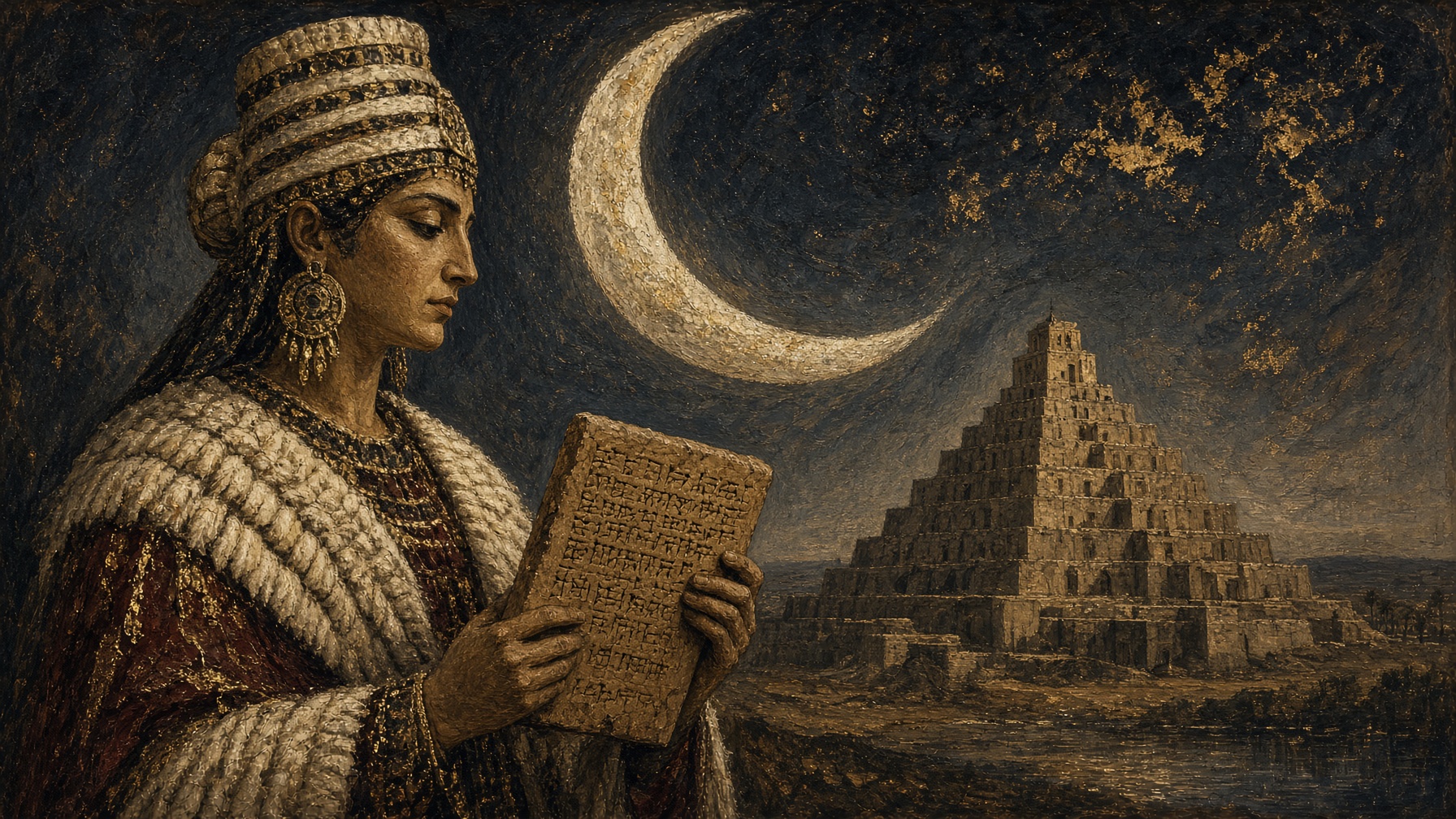
Ur · ~2300 BCE
She signed her name
Hear
Eve · history first
Eve reads this plate. Not the whole room. No autoplay.
No autoplay. Press play if you want to hear Eve. The words she reads will open below.
High priestess of the moon god Nanna in the city of Ur. Daughter of Sargon of Akkad. Around 2300 BCE she spoke, recorded, and signed. Before her, sacred speech was attributed to the gods.
Then a coup. A new king had no need of the first voice. She was cast out of Ur. In exile she wrote to Inanna, not as a broken woman, as an equal addressing an equal across the threshold of the sacred. The tradition says she was restored. She returned to the temples. She sealed the work with a colophon. The last hymn of the cycle is where the name stands.
The wider story already lives in The Book of 42. CIPHER’s job is narrower. Original language first. The clay is Sumerian and Akkadian. What follows is a modern Latin-letter spelling under a modern English machine. It is not a claim that her ancient name encoded 42.
ENHEDUANNA
ENGLISH REDUCTION
42
Apparently. One face.
Not Sumerian. Not Akkadian. Enheduana and En-ḫedu-ana are distinct strings. They do not inherit 42.
Four faces. One lock.
English letters. Hyphens stripped. That 42 is not the same fact as the forty-two temple hymns attributed to her. Two kinds of number. Both filed on Inanna. Cipher is not Sumerian.
Does not lock.
Does not lock.
The lock. One face.
48. Not the hymns. Not 42.
English reduction · the lock
42
E 5 + N 5 + H 8 + E 5 + D 4 + U 3 + A 1 + N 5 + N 5 + A 1 = 42. The poet bound to the road. Not Sumerian.
English ordinal · a miss
53
I 9 + N 14 + A 1 + N 14 + N 14 + A 1 = 53. Reduction 26. Reverse 109. Reverse reduction 37. No 24. No 42.
Noticed. Not sat.
42
Reverse reduction. I 9 + S 8 + H 1 + T 7 + A 8 + R 9 = 42. A later Akkadian name for the same goddess-field. Not the road’s name. Not the poet’s. Not a second plate.
The tablet first
Those objects live in the surviving Sumerian poem Inana’s Descent to the Nether World, not in Enheduanna’s hymn-cycle. Different poem. Same goddess-field. CIPHER is still counting the poet. The gates walk next door.
In the ETCSL composite, the rod and line leave her hand at the sixth gate. One manuscript places that removal at the first gate. The witnesses do not fully agree. CIPHER will not pretend they do.
When Ninšubur begs, the plea is not for jewelry. It is Inanna compared with stone that must not be worked. Conventional literary comparison, paired with metal that must not be alloyed and boxwood that must not be cut. The Sumerian is za-gin sa6-ga, beautiful or precious lapis. The goddess is not being renamed a necklace.
Worn
Small lapis-lazuli beads around her neck
The tablet names them before any gate.
Held
Measuring rod and measuring line
Lapis instruments of measure. Office, not ornament.
Removed
Sixth gate in the composite
One manuscript: the first gate. Variant is not default sequence.
Compared
“Don’t let your precious lapis lazuli be split”
She is the stone that must not be worked. Not a necklace renamed.
The number did not put the lapis in Inanna’s hand. The tablet did.
Then we counted the English phrase. LAPIS LAZULI reverse-reduces to 69. ENKI reverse ordinal is 69. Same integer. Different faces. Do not flatten them. Not a plate. The descent walks next door.
That she encoded English. That Sumerian is this cipher. That forty-two hymns were designed as gematria.
That every 42 hymn-count is the same object as Numbers 33 or Maʽat. That 1969 was chosen for 69. That LAPIS LAZULI reverse-reducing to 69 put the stone in the poem.
History first. Then the cipher. ENHEDUANA, without the second n, is 37 under the same machine. A miss. The spelling that locks is the spelling that was counted. Nothing else may borrow it.
History first.
Then the cipher.
Notes